Netra Chhetri: Biochar as a Renewable, Carbon-Neutral Energy Source
Written by: Bate Tabenyang Alaine, Research Fellow NCEC and Caleb Lieberman, GFL Intern
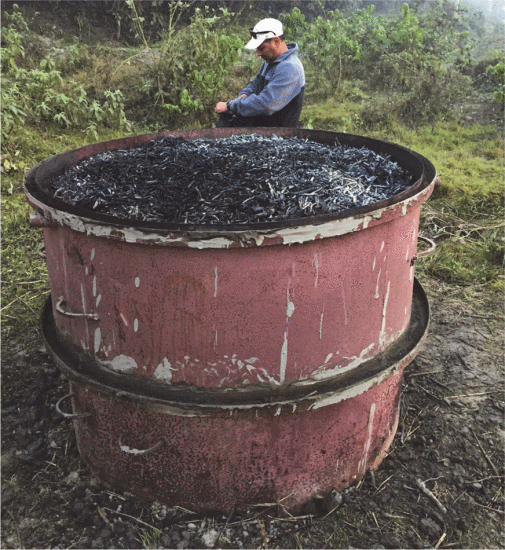
Fig. 1 Three part kiln used for biochar creation in Amaltari from Namuna. From: Lessons in Biochar: Advancing Research Through Service Learning Courses in Nepal
Biochar is a renewable energy source that tackles both waste and carbon emissions to provide clean and affordable energy in agricultural and forestry communities, transforming biomass waste into a solid, carbon-rich material through a low-oxygen heating process that can be returned to soils or used to generate clean energy, creating a sustainable, renewable energy source with carbon-neutral impact.
“Biochar, if sequestered in the soil, can make soils carbon-negative,” explains Professor Netra Chhetri. “If the biochar is used as a source of energy, then it becomes carbon-neutral… In other words, you’re recycling carbon between the atmosphere and vegetation.”
About Professor Netra
For more than a decade, Professor Netra has been at the forefront of advancing innovative solutions and approaches to climate adaptation that integrates scalar processes between environmental dynamics and social outcomes. Working at the complex intersections of climate change adaptation, food security, resource governance, grassroots innovation, and public engagement, Professor Netra's skill set allows him to scale through the boundary of knowledge and practice, so that each reinforces the other.
As a scholar, his efforts to develop a method for assessing the multiple sources of environmental impacts on society are peculiar and a significant tool for designing and prioritizing climate adaptation strategies. As a practitioner, he has more than a decade of experience working at the complex intersection of science and policy and developing the most promising solutions that focus on scalability, impact, and sustainability.
Recognition
Professor Netra's expertise in global food security has evolved to focus on the impacts of climate change on global food systems, leading him to be one of the contributing authors to the Fourth (2007) and Fifth (2014) Assessment Reports of the United Nations Intergovernmental Panel on Climate Change (IPCC). His work appears in numerous prestigious and peer-reviewed publications, including Nature and the Journal of the National Academy of the Sciences. He is also a member of a team exploring how biofuel crops such as perennial grasses can be grown sustainably in the United States. Professor Chhetri regularly teaches Global Change, Human and Social Dimensions of Climate Change, and Cultural Perspectives on Sustainability.
His consistent contributions to biochar and food-systems research have also been widely recognized through competitive funding. In 2016, he received a Solutions Advancement Grant for Entrepreneurship (SAGE) from the Food Systems Transformation Initiative of the Global Institute of Sustainability for his project “Climate-smart agriculture and biochar.” That same year, he was named a finalist for the Andrew Carnegie Fellow Program, nominated by the ASU President, for his proposal “Climate resilience through innovation: Crop-livestock systems in the Hindu Kush Himalayas.” As a testament to his wealth of experience, Professor Netra connects this record of recognition directly back to the classroom.
“We need to teach young people not just about biochar, but about navigating complexity and valuing diverse solutions,” he says. “Young people like you are the future.”
How Biochar Works
Biochar, created by burning organic waste in an oxygen-deprived environment, has several potential uses, including improving soil fertility in agricultural applications, substituting for firewood as a household energy supply, and acting as a water filtration medium alongside its carbon sequestration capabilities. Find details linked and excerpts below on biochar from his co-authored piece: Lessons in Biochar: Advancing Research Through Service Learning Courses in Nepal by Mark Henderson, Netra Chettri and Fiona Johnson.
Sequestration of biochar is estimated to offset global anthropogenic greenhouse gas emission by full 12 percent CO2-e (1.8 GT CO2 yr−1) without endangering food security, habitat or ecosystem services. Every ton of biochar applied to the soil is equivalent to 0.61 to 0.80 ton of carbon (i.e. to 2.2 to 2.93 tons of CO2) sequestered. At a time when geo-engineering is attracting growing interest as a potential option for keeping global warming below 2°C, carbon sequestration possibilities of biochar are seen as a promising route to climate mitigation.
“One common mistake is that people treat biochar like fertilizer. It’s not. It’s a medium that helps fertilizers work more effectively. It holds nutrients in place, prevents leaching into water bodies, and even protects aquatic ecosystems,” Netra explains. “Right now, we talk mostly about soil, but high-quality biochar can also be used as a water filter. An activated biochar is used in labs to purify water just like a Brita filter.”
A Closer Look at the Amaltari, Nepal Case Study
Students from Arizona State University (ASU), University of New South Wales (UNSW), and Nepal's Tribhuvan University (TU) have engaged in three service learning courses in the small community of Amaltari, Nepal, investigating the sustainable supply of biomass and analysing the costs and benefits of biochar production in the community. Located in south-central Nepal, Amaltari is one of the buffer zone communities across Chitwan National Park. The research assesses the feasibility of using invasive plant species; Mikania micrantha and Lantana camara as the biochar feedstock.
Why It Matters
The main differentiating feature of this research is that it focuses on science-based and community-led innovation, co-generating solutions by integrating students and faculty from engineering and sustainability with the local biochar company and the buffer zone community of Amaltari. The case study shows that on-the-ground experiential and multiple stakeholder engagement processes spanning sustainability, engineering, and cultural anthropology have the potential to address ‘wicked’ environmental problems.
In His Own Words: Overcoming the Barriers to Biochar
Asked why a solution this promising hasn’t taken off at scale, Professor Netra points to culture rather than science. “It’s not a science or technology problem; we understand it well,” he says. “The real barrier is cultural. In some academic or political circles, we tend to overlook solutions that look too simple or not glamorous enough. People don’t get excited about ‘black dirt.’”
He sees particular opportunity in wildfire-prone regions like the American West. “In places with dry climates and excess biomass, it’s like standing on a matchbox,” Netra explains. “Why not use that biomass before it burns? Turn it into pellets or char and use it for heat or agriculture. We have the technology.” He adds that the same closed-loop thinking applies close to home: cities like Phoenix generate constant streams of landscaping biomass that could be converted into biochar rather than sent to landfills, where it decomposes and releases methane.
For More Information Professor Netra: https://search.asu.edu/profile/844268